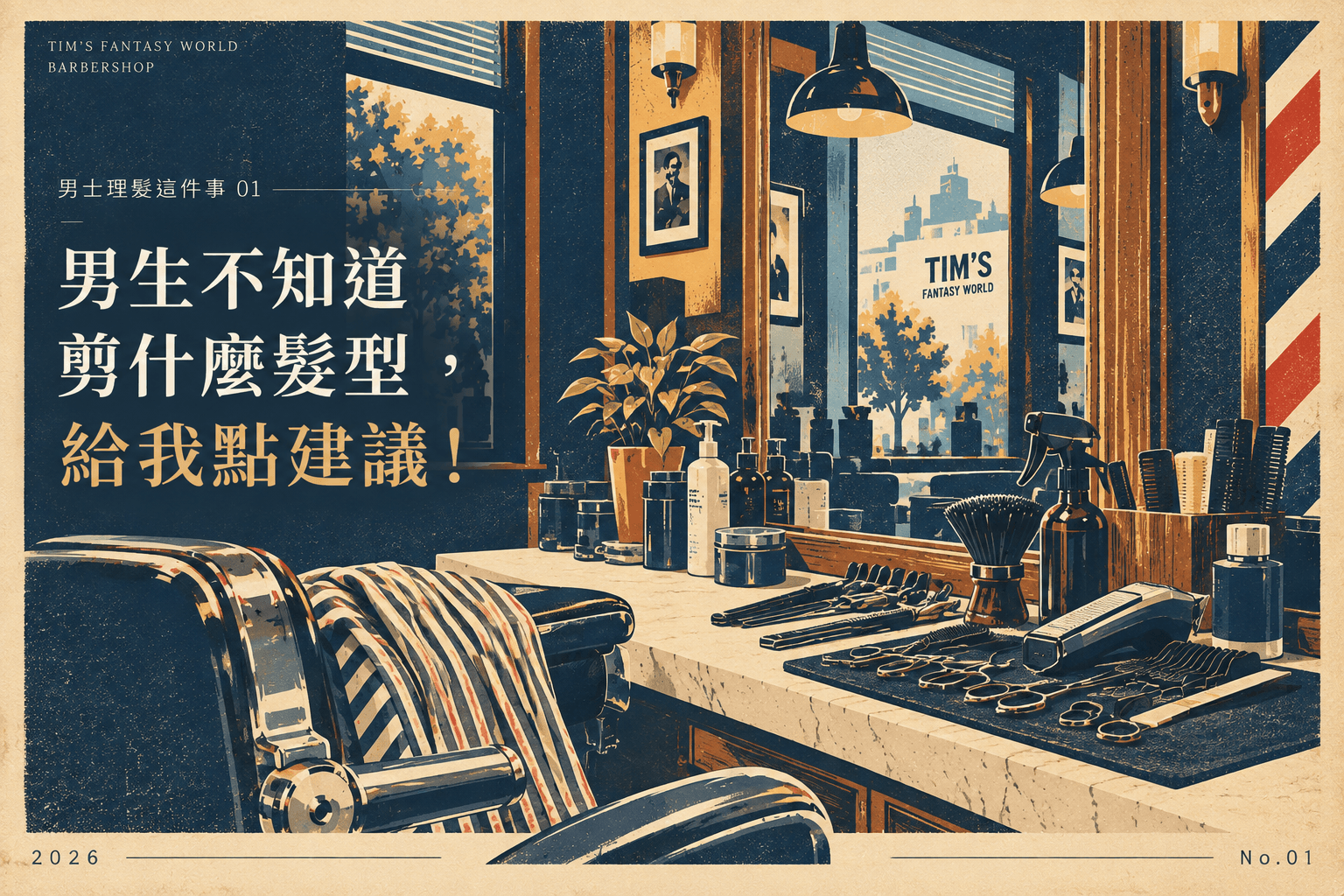
"I don't know what to get cut. Could you take a look and see what hairstyle would suit me?"
This is probably the phrase hairstylists hear most often.
Before walking into a hair salon, many guys may only know that they want a shorter cut, a new look, or simply feel that their current hairstyle is hard to manage. But once they’re seated, they often find it difficult to articulate exactly what they want.
This is totally normal.
After all, finding the right hairstyle for someone isn’t just as simple as “choosing a style.”
What's right for you isn't necessarily what's most popular right now.
When you see a photo of a hairstyle you like, your first reaction is usually:
"I want a look like this!"
Photos can certainly serve as a reference, but the same hairstyle will inevitably look different on different people.
Even with the same center part, some people’s hair naturally dries with a beautiful curve, while others’ hair lies flat against their scalp.
Therefore, whether a hairstyle suits you or not really depends on a number of factors, including the following:
Head shape, face shape, hairline, hair flow, hair volume, hair texture, and how you usually style your hair.
So rather than asking:
"What's trending this year?"
We should be even more aware that:
"What kind of hairstyle suits you best?"
First things first: Take a look at how your hair grows.
Many people consider their face shape first when choosing a hairstyle, butHair texture and head shape are actually equally important.
Some people are born with hair that grows in a specific direction on both sides of their head, while others have a flatter back of the head—these are all natural characteristics unique to each individual. These characteristics don’t necessarily need to be corrected; a good haircut actually begins by understanding how the hair naturally grows, then determining which sections to keep, which to trim, and how to shape the overall silhouette.
Sometimes you might feel like your hair is “hard to manage,” but the problem isn’t necessarily that you don’t know how to style it. It could simply be that your current length and cut aren’t working with the natural flow of your hair.
Second: Your hair type determines a lot of things
"The photo looks great when it's cropped like this—why can't I do it?"
A very common reason is thatHair types vary.
Fine, soft hair tends to lie flat and lose volume easily, so you usually need to consider both support and weight; coarse, thick hair has natural body, but if cut too short, the sides can end up looking frizzy. Natural curls don’t necessarily mean you have to straighten your hair—some natural waves can actually create a beautiful texture.
So when we see a photo we like, we don’t necessarily copy it exactly; instead, we analyze it:
What do you really like?
Is it the length of the bangs?
That fluffy feeling on top of your head?
Clean lines on both sides?
Or does it look more natural overall?
Third: Your lifestyle is also a factor.
This is something that's easy to overlook.
Just because a hairstyle looks great before you leave the salon doesn't mean it will necessarily suit you once you get home.
If you only have five minutes to style your hair each morning, you shouldn’t choose a hairstyle that takes a long time to create and requires multiple styling products. If you ride a bike every day and wear a helmet for long periods, you should also consider whether your hairstyle can be restyled after being flattened by the helmet.
Even something as simple as “how often you’re willing to get a haircut” can influence your choice. With some short hairstyles, the shape begins to change after two or three weeks; with medium- to long-length hair, however, the style can gradually evolve as the hair grows.
So, for us, lifestyle habits should naturally be part of the hair styling process.
It's okay if you have "absolutely no idea what to cut"
For first-time customers who really have no idea what they want, you can simply tell the stylist:
"I don't like it when the sides are too voluminous." "I'm not very good at styling it in the morning." "I want to grow it out, but it's a mess right now." "I don't want it cut exactly the same way as before."
This information is very useful for hairstylists. If you have any photos, feel free to bring them along to discuss.
It can help you both understand each other's likes and dislikes more quickly.
Sometimes bringing three photos of styles you like can help the stylist understand exactly what you want better than just saying the name of a hairstyle.
A hairstyle isn't about choosing an answer—it's about finding the answer together.
It might seem like there aren't that many options when it comes to men's hairstyles, but when you get down to the nitty-gritty, there are actually a lot of details to consider.
Even with short hair, you can adjust the shape, the depth of the layers, and the texture. Even with a center part, you can go for a clean, sharp look or a natural, loose one.
Even if it’s just a matter of “not changing too much,” you can still use small details to make the whole thing better suited to who you are today.
So the next time your hairstylist asks, “How would you like your hair cut today?”
If your mind is still a blank, there's no need to feel embarrassed.
Not knowing what kind of haircut you want can actually be a great way to start a consultation.
What’s our take on this?
As hairstylists, rather than focusing on “what hairstyles are currently in style,” we’re more interested in the natural condition of your hair, how you usually style it, and the look you’re hoping to achieve.
A good hairstyle shouldn't just look good before you walk out of the salon.
When we get back to our daily lives, if we still find ourselves thinking, “Hmm! I’m really happy with this,” after blow-drying and styling our hair ourselves—that’s what we truly want to do.